 How-to
Why Your Car Key Fob Stopped Working: 7 Fixes
Table of Contents
- Why Your Car Key Fob Stopped Working: Common Causes
- How to Reprogram a Car Key Fob
- Car Key Fob Battery Replacement Cost and Process
- Signal Interference and Other Environmental Factors
- Vehicle Receiver, Antenna, and Fuse Problems
- Automotive Key Fob Programming Services: DIY vs. Professional
- Troubleshooting Checklist: Diagnostic Steps
- Frequently Asked Questions
Last Updated: August 29, 2026
Why Your Car Key Fob Stopped Working: Common Causes
Your car key fob stopped working at the worst possible time. Before you panic or head to the dealership, understand that most key fob failures come from a handful of predictable causes. Many are fixable without professional help.
A dead or weak battery is the most common culprit, but corrosion, physical damage, and signal interference can all render your fob useless. Understanding what's actually broken determines whether you can fix it yourself or need to call a professional locksmith like JFJ Locksmith for automotive module programming and key reprogramming.
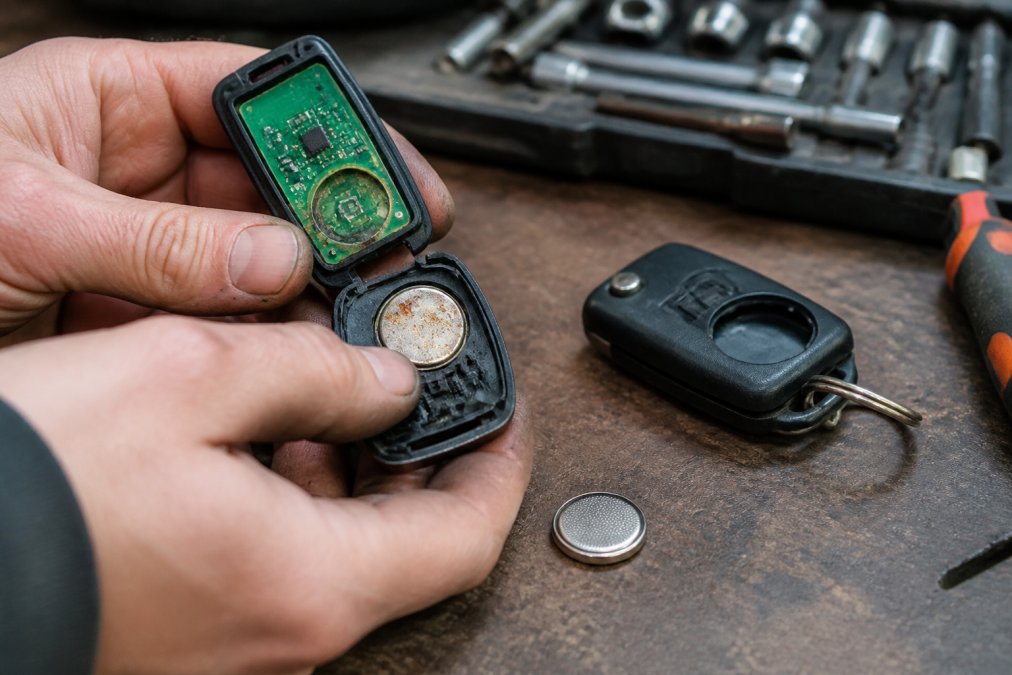
Dead or Weak Battery
The battery inside your key fob typically lasts between three and four years under normal use (peer-reviewed research). When it dies, your fob stops transmitting the signal your vehicle's receiver needs to unlock doors or open the trunk. A weak battery might work intermittently, the fob works when you're close to the car but fails at distance.
Most car key fobs use a CR2032 or CR2025 lithium coin cell battery (the FDA). These are inexpensive and widely available at pharmacies, supermarkets, and hardware stores. Try replacing it first. If the fob suddenly works again after a fresh battery, you've solved the problem for another few years.
Worn-Out or Damaged Buttons
The buttons on your key fob endure thousands of presses over years of use. The rubber dome beneath each button eventually wears out, or the conductive material degrades. When this happens, pressing the button doesn't complete the circuit needed to send a signal.
Physical damage accelerates this process. Drop your fob on concrete, and the impact can crack the button contacts or misalign internal components. Water damage from spills or moisture exposure can corrode the button contacts, preventing proper electrical contact.
If only one button stopped working, the problem is likely isolated to that button. If multiple buttons fail simultaneously, the issue probably lies deeper in the circuit board.
Internal Circuit Board Corrosion
Moisture is the enemy of electronics. When water or humidity seeps into your key fob, it corrodes the circuit board and its components. Corrosion appears as green or white crusty deposits on the metal traces and solder joints inside the fob.
Even brief exposure to moisture, leaving your fob in a pocket that gets rained on or accidentally dropping it in a puddle, can start the corrosion process. Over time, corroded connections fail, and your fob stops working.
Physical Damage to the Fob Casing
A cracked or broken plastic casing exposes internal components to dust, moisture, and physical stress. A small crack allows water to seep inside and compromises the structural integrity that keeps button contacts aligned.
Severe cracks or a split casing usually require replacement. Attempting to glue a fob back together might hold it temporarily, but internal alignment will be off, and buttons won't press correctly. The antenna inside the fob can also be damaged if the casing breaks in the wrong place, preventing signal transmission entirely.
How to Reprogram a Car Key Fob
Sometimes your car key fob stopped working not because the fob itself is broken, but because it lost its pairing with your vehicle's receiver. Reprogramming reestablishes that connection. Many vehicle owners can reprogram their fobs at home using a simple sequence of button presses and key turns.
DIY Reprogramming Steps
The exact reprogramming procedure varies by vehicle make and model, but most follow a similar pattern. Start by sitting in the driver's seat with all doors closed and the key in the ignition.
- Turn the key to the "On" position without starting the engine. Wait for the dashboard lights to illuminate.
- Turn the key back to "Off." Repeat this cycle (On, Off, On, Off) several times until the vehicle enters programming mode. Most vehicles indicate this with a chime or flashing lights.
- Press any button on your key fob. The vehicle should respond with a chime or light flash, confirming the fob is paired.
- Repeat with additional fobs if you have backup remotes.
- Turn the key to the "Off" position to exit programming mode.
The entire process typically takes fewer than five minutes. If your vehicle doesn't respond, consult your owner's manual for the specific procedure for your make and model. Some newer vehicles require professional diagnostic equipment to reprogram fobs, which is where automotive key fob programming services from a locksmith become necessary.
When Reprogramming Won't Work
Reprogramming only works if your fob is actually transmitting a signal. If the fob's battery is dead, the buttons don't work, or the circuit board is corroded, reprogramming won't help. A fob that's physically broken needs repair or replacement, not reprogramming.
Additionally, some vehicle security systems prevent reprogramming without the original factory fob or special equipment. Luxury and newer model vehicles often have immobilizer systems that require dealership-level programming or a professional automotive locksmith with specialized equipment.
If you've tried reprogramming and your fob still doesn't work, the next step is battery replacement or professional diagnosis.
Car Key Fob Battery Replacement Cost and Process
Replacing the battery in your key fob is the cheapest and easiest fix. The battery itself costs between $3 and $8, and the process takes under five minutes (consumer.ftc.gov).
Replacing the Battery Yourself
Open your fob carefully by locating the seam where the two plastic halves meet. Most fobs have a small slot or groove where you can insert a coin or flat screwdriver to pry them apart gently. Avoid forcing it; if the fob doesn't separate easily, you might be prying in the wrong spot.
Once open, note the battery's orientation (positive side up or down). Remove the old battery and replace it with a fresh one of the same type. Close the fob gently and test it near your car. If it works, you're done. If not, try flipping the battery orientation; some fobs require the positive side facing down.
Most replacement batteries are CR2032 or CR2025 lithium coin cells, found at any pharmacy or grocery store. Keep a spare battery in your car's glove compartment so you're never stranded with a dead fob.
When to Replace vs. Repair
A new battery costs $3 to $8 and solves the problem in most cases. A complete fob replacement from a dealership typically costs more, but a professional locksmith like JFJ Locksmith can often reprogram an existing fob or provide a replacement at a lower cost than dealership pricing.
If your fob has a cracked casing or visible corrosion, replacement is usually more reliable than repair. Professional automotive locksmiths have experience determining whether a fob can be salvaged or needs replacement.
Signal Interference and Other Environmental Factors
Your key fob transmits on a specific radio frequency to communicate with your vehicle's receiver. Interference from other devices operating on the same frequency can block the signal, making your fob seem broken when it's actually working fine.
Common sources of interference include cell towers, power lines, and radio stations. Airports and military bases also emit strong signals that can jam key fob frequencies. If your fob works fine at home but fails in certain locations, signal interference is likely the culprit.
RFID-blocking wallets and signal-blocking pouches designed to protect credit cards can also block your key fob's signal if the fob is stored inside them. Remove your fob from any blocking wallet or case before trying to unlock your vehicle.
Environmental factors matter too. Extreme heat can damage battery chemistry and degrade plastic components. Extreme cold can temporarily reduce battery voltage, making the signal too weak to reach your vehicle's receiver. Most key fobs work normally once they warm back up.
Vehicle Receiver, Antenna, and Fuse Problems
Sometimes your key fob stopped working because the problem isn't with the fob, it's with your vehicle's receiver, antenna, or electrical system.
Blown Vehicle Fuses
Your vehicle's keyless entry system is protected by a fuse in the main fuse panel. A blown fuse cuts power to the receiver, making it impossible for your car to respond to any key fob signal. Check your owner's manual to locate the keyless entry fuse, then inspect it for a broken filament or blackened appearance.
Replacing a blown fuse is simple: locate the correct fuse, pull it out, and insert a new one of the same amperage. If the fuse blows again immediately after replacement, there's an underlying electrical problem that requires professional diagnosis.
Faulty Antenna or Receiver Issues
Your vehicle's receiver antenna is usually located near the door locks or in the dashboard. If the antenna is damaged or the receiver module fails, your car won't detect signals from any key fob, even a brand-new one that works on other vehicles.
Diagnosing receiver or antenna problems requires specialized diagnostic equipment. If you've confirmed your fob's battery is good, the buttons work, and reprogramming didn't help, the issue likely involves your vehicle's receiver system. This is where professional help becomes necessary.
Automotive Key Fob Programming Services: DIY vs. Professional
Deciding whether to fix your key fob yourself or hire a professional depends on the problem's complexity and your comfort level with electronics.
What Professional Locksmiths Can Do
A professional automotive locksmith has diagnostic equipment that identifies exactly what's wrong with your fob or vehicle's receiver. They can reprogram fobs for vehicles with complex security systems that don't respond to standard DIY procedures. They also have access to replacement fobs and can program them to your specific vehicle.
JFJ Locksmith specializes in automotive module programming and precise key programming. Our team handles modern vehicles with advanced security systems that require specialized equipment and expertise. If your vehicle's receiver is faulty, we can diagnose and repair it. If your fob is damaged beyond repair, we provide replacement fobs programmed to your exact vehicle specifications.
Professional locksmiths understand vehicle-specific quirks. A 2020 Honda's reprogramming procedure differs from a 2023 Chevrolet's, and luxury vehicles often require different approaches than standard models.
Cost and Timeline Comparison
DIY battery replacement costs $3 to $8 and takes five minutes. Professional fob programming typically costs more but handles complex problems that DIY methods can't solve. Professional automotive locksmith services are generally less expensive than dealership options.
Timeline matters when you're locked out of your vehicle. DIY battery replacement is instant. Professional locksmith services usually respond faster than dealership appointments, which can take days or weeks to schedule.
Troubleshooting Checklist: Diagnostic Steps
Use this checklist to systematically identify why your car key fob stopped working. Start at the top and work your way down.
| Step | Action | Expected Result | Next Step if Failed |
|---|---|---|---|
| 1 | Replace battery with fresh CR2032 or CR2025 | Fob works normally | Proceed to Step 2 |
| 2 | Try fob near your ear; listen for clicking sound | Faint click when pressing buttons | Proceed to Step 3 |
| 3 | Inspect fob for cracks, water damage, or corrosion | No visible damage | Proceed to Step 4 |
| 4 | Try reprogramming using your vehicle's standard procedure | Vehicle responds; fob works | Problem solved |
| 5 | Test fob in different location away from interference | Fob works in new location | Signal interference likely |
| 6 | Check vehicle fuses related to keyless entry | Fuse is intact | Professional diagnosis needed |
If you complete all steps and your fob still doesn't work, the problem likely involves your vehicle's receiver system or a hardware failure in the fob that requires professional repair or replacement.
Frequently Asked Questions
Q: Why did my car key fob stop working out of nowhere?
A: The most common reason is a dead or weak battery, which typically lasts 3-4 years depending on usage frequency. Other sudden failures stem from water damage, button contact wear, internal circuit board corrosion, or signal interference from nearby electronics. If your fob worked fine yesterday, start by replacing the battery with a fresh lithium coin cell. If the issue persists, the circuit board or button contacts may be damaged and require professional repair or replacement.
Q: How do I reprogram a car key fob if it stops responding?
A: Many vehicles allow DIY reprogramming by turning the ignition on and off in a specific sequence while pressing buttons on the fob. The exact procedure varies by make and model, so check your owner's manual for the correct reset sequence. Insert the key, turn to On, then Off, then On again (without starting the engine), and listen for a chime or watch for lights to flash. Press any button on the fob to complete pairing. If this doesn't work, your vehicle's receiver or immobilizer module may need professional diagnostic testing and programming through specialized automotive equipment.
Q: What is the typical cost for car key fob battery replacement?
A: A replacement lithium coin cell battery costs $3-$15 if you replace it yourself, making this the cheapest fix. Professional battery replacement at a locksmith typically ranges higher due to labor and diagnostics. If the entire fob is damaged beyond battery issues, replacement costs depend on your vehicle make and model. Contact JFJ Locksmith for a quote on professional replacement or programming services, as pricing varies based on your specific vehicle and the work required.
Q: Can I still drive my car if my key fob stops working?
A: Yes, if your vehicle has a traditional key blade inside the fob, you can unlock the door and start the engine manually. However, if your car uses push-to-start and keyless entry exclusively, you may be locked out until the fob is repaired or replaced. Some vehicles have emergency key slots or blade keys hidden inside the fob casing. Modern vehicles with transponder chips require the fob's signal to be recognized by the immobilizer system to start the engine, so a completely non-functional fob prevents starting even with the physical key blade.
When your car key fob stopped working, the solution often sits in your glove compartment or costs just a few dollars at the nearest pharmacy. But when DIY fixes don't work, you need someone who understands automotive security systems and has the equipment to diagnose and repair complex problems. Get in touch with JFJ Locksmith, and we'll have you back on the road with a working key fob and peace of mind that the job was done right.